




Industries We Serve
QSRs (Quick Service Restaurants)
Indian F&B Consulting
Quick Service Restaurants move fast. Customers expect quick prep, consistent taste and smooth delivery. In India’s competitive F&B market, even small mistakes in food cost, staffing, workflow, aggregator ranking or menu pricing can reduce profit. BudgetBytes supports QSR brands with end-to-end consulting that improves operations, strengthens P&L, boosts online orders and creates systems that scale easily.
Our team works with QSRs, fast-food outlets, multi-brand kitchens, cloud kitchens, franchise chains, bakery QSRs and beverage QSR formats across cities. We help brands cut food cost, reduce wastage, improve Swiggy and Zomato visibility, build stronger menu engineering, and streamline every part of the QSR workflow.
We combine market research, QSR menu engineering, food cost control, sourcing optimization, digital transformation, team training and aggregator management to create a profitable and stable model. This helps QSRs grow faster in Tier 1, Tier 2 and Tier 3 cities while reducing daily operational pressure.
Quick Service Restaurants in India grow fast, but they also face daily problems that hurt revenue, online orders and long-term profitability. The market is competitive, food costs keep changing, and aggregator platforms control most of the demand. Without the right systems, even good QSR brands struggle to stay stable.
Here are the biggest challenges QSRs deal with today:
Most QSRs run on thin margins. Even a small jump in ingredient prices affects gross profit. Weak vendor negotiations, no portion control and inconsistent recipes increase food cost even more.
Many QSRs lose orders because they do not rank well on delivery platforms. Poor menu structure, weak category mapping, bad photos and slow order acceptance push listings down and reduce conversions.
Without SOPs, staff training and controlled prep steps, the same dish tastes different on different days. Inconsistency leads to low ratings, fewer repeat customers and negative reviews.
QSRs get most of their orders during lunch and dinner rush. If the kitchen workflow is slow or confusing, orders get delayed, ratings fall and cancellations increase.
The QSR industry depends on young and rotating staff. Without proper training modules and clear roles, staff exit quickly. This increases cost and reduces efficiency.
Many QSR menus are built without data. Wrong pricing, too many low-margin items and weak combo creation reduce contribution margins and overall profits.
Improper storage, inaccurate forecasting and weak monitoring cause waste in raw materials, packaging and manpower. This silently reduces daily profit.
Many QSRs want to open more outlets or franchise, but without clear SOPs, operations manuals, training modules and performance dashboards, scaling becomes risky and inconsistent.
BudgetBytes has helped QSR brands across India achieve real growth using data-driven planning, menu engineering and strong operational support.
Our consulting improves:
We optimize QSR menus, pricing and delivery systems to bring more orders every day.
Better prep time, consistent taste and strong packaging raise customer trust.
Tighter sourcing, portion control and menu engineering improve gross margin.
We reduce bottlenecks, redesign workflows and train staff for efficiency.
We help QSRs dominate local search, social media and delivery platform visibility.
With systems in place, QSR brands scale easily to multiple outlets.
With SOPs and training, every outlet delivers the same quality and experience.
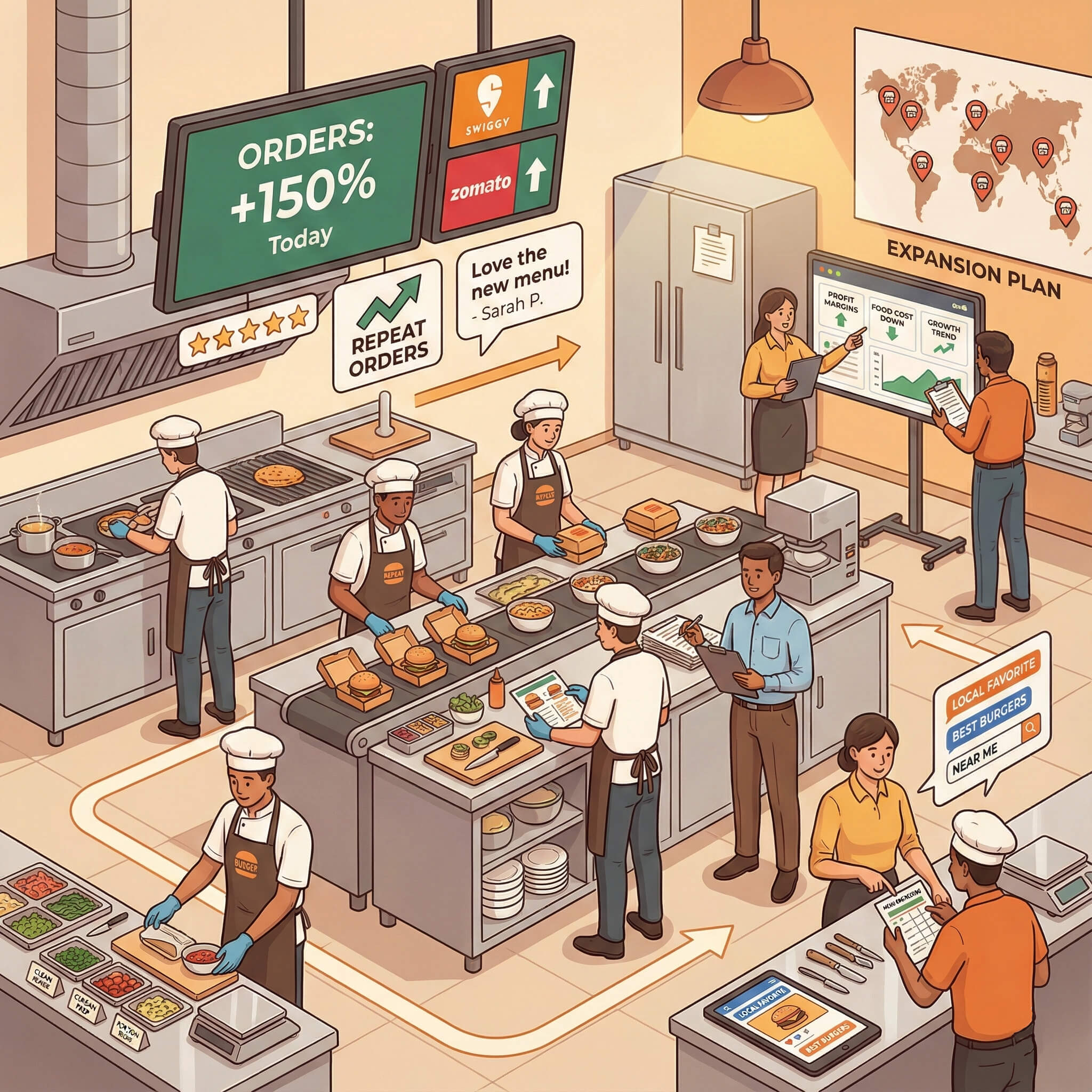
Stronger Systems. Faster Service. Higher Profit.
Quick Service Restaurants need speed, consistency and control. We help QSR brands fix daily operational issues, reduce food cost, improve Swiggy and Zomato rankings and build a smooth kitchen workflow that works even in heavy rush hours. Our team sets up the right systems, trains your staff, improves menu profitability and makes sure every outlet performs better, both online and offline.
QSR Growth & Franchise Consulting India
QSR consulting helps fast food and quick service restaurants improve operations, food cost, menu engineering, and delivery platform performance. It strengthens profitability, increases order volume, and creates systems that support scale across multiple outlets.
Controlling food cost in QSRs requires better vendor sourcing, portion standardisation, prep control, and menu engineering. Analysing top-selling and low-margin items helps improve gross profit and overall P&L performance.
Menu engineering helps identify profitable items, reduce slow movers, and simplify prep time. For QSR brands, a well structured menu improves kitchen speed, boosts online conversions, increases average order value, and enhances delivery platform visibility.
Improving prep time requires streamlined kitchen workflows, station-wise SOPs, ready-to-cook systems, and batch preparation. These changes increase speed during peak hours and help QSRs maintain consistency across multiple outlets.
Optimising your Swiggy and Zomato presence improves ranking, visibility, and conversions. Updating menu photos, pricing, item placement, and running targeted promotions helps QSRs increase orders and grow daily online revenue.
Peak hour efficiency comes from clear prep cycles, batching, real-time order tracking, and well trained staff. Simplifying the menu and improving station coordination helps maintain accuracy and delivery time even when orders spike.
Digital transformation helps QSRs automate billing, inventory, order flow, and reporting. Using POS systems, kitchen screens, and analytics dashboards reduces manual errors and improves speed, accuracy, and outlet performance.
QSR profitability improves when food cost, labour cost, wastage, pricing strategy, and vendor sourcing are managed well. Regular P&L monitoring helps identify leakages and strengthen overall financial performance.
Yes. With standardised SOPs, recipes, training modules, and quality control systems, QSR brands can expand smoothly. Strong operational processes make it easier to scale into new locations and even build a franchise model.
Most QSRs begin seeing improvement in prep time, order accuracy, ratings, and online sales within 30 to 60 days. With consistent tracking and optimisation, long-term growth becomes stable and predictable.